



Digital sovereignty comes down to control. Who controls your data, who runs the infrastructure it lives on, and who governs the AI systems that make decisions from it?
The pressure is growing on several fronts. Regulation keeps multiplying, enforcement has become expensive, and the European Commission's Technological Sovereignty Package now covers cloud, AI, semiconductors, and open source at policy level.
It helps to see digital sovereignty as a stack, with each layer building on the one below: data, cloud, and AI. Here's what each layer means and how intive helps organizations put it into practice.
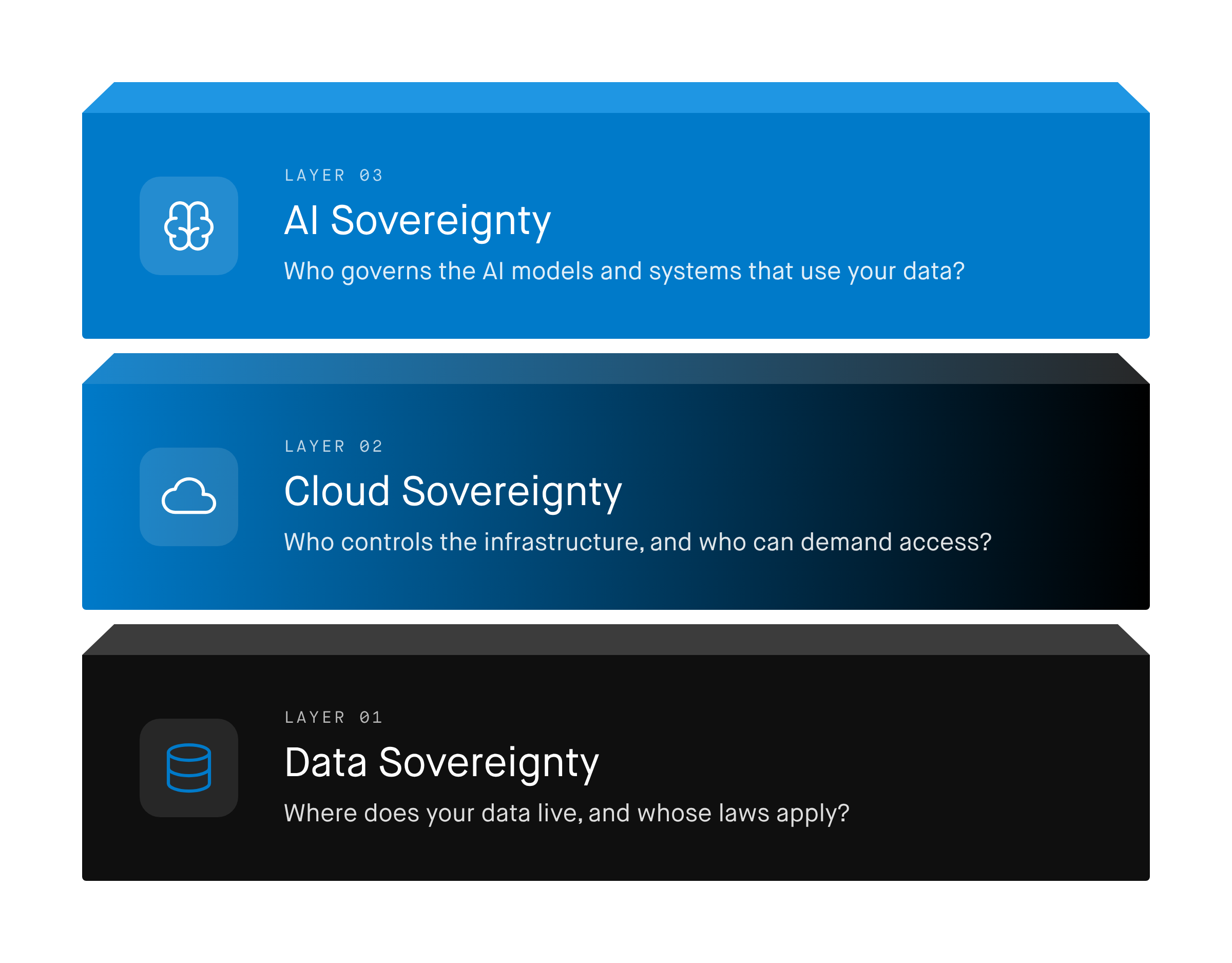
Data sovereignty: where your data lives and who governs it
Two terms often get mixed up here. Data residency means keeping data – and, in stricter readings, its processing – inside a set geographic boundary, usually a country or region. Data sovereignty goes further: it's about who has authority over that data and whose laws apply to it. In short, one is about location, the other about authority.
Rules about where data must be kept are older than cloud computing. Financial, healthcare, and national security rules have long put geographic limits on certain data. The cloud adoption made this harder. Data is now often copied across data centers in several countries, so it’s no longer easy to say where it actually is. The EU’s General Data Protection Regulation (GDPR) set the EU baseline in 2018, the Schrems II ruling (2020) struck down the main legal basis for transferring data from the EU to the US, and comparable laws have since appeared in dozens of jurisdictions, from India to Brazil.
Enforcement has sharpened too. In 2023, Meta was fined €1.2 billion for unlawful EU-US data transfers. In 2025, TikTok received a €530 million fine for sending European data to China without adequate safeguards. Both cases make the same point: regulators are willing to act, however big the company.
Many large organizations have already covered residency for their primary cloud estate. The gaps usually sit elsewhere: SaaS vendors that store data in-region but run support and AI processing outside it, the infrastructure used to run and train AI models, which gets less scrutiny than storage, and access logs and system monitoring data routed outside the jurisdiction. The organizations doing this well see it as an engineering task as well as a legal one. They track how data moves between systems, check vendors' actual contract terms instead of their published privacy statements, and add residency requirements to procurement from the start.
Cloud sovereignty: who controls the infrastructure
Cloud sovereignty describes how much control you keep over your data and infrastructure once an external cloud provider hosts them. Three questions matter most:
- whose laws apply to that infrastructure,
- who can legally demand access to the data on it,
- and whether your operations keep running if the provider changes its pricing, terms, or service.
This is where data residency alone falls short. Your data can sit in Europe and still fall under another country's laws. Under the US CLOUD Act (2018), US authorities can require any US-incorporated company to hand over data, wherever in the world it's stored. Each of the three largest global cloud providers is a US company, and placing data centers or sovereign zones in the EU leaves the parent company's legal obligations unchanged. The major cloud providers (hyperscalers) have responded with tighter staff access rules, dedicated infrastructure, and stronger contract terms. These help, but the parent company is still bound by US law. Meanwhile, a separate market of EU-sovereign platforms has emerged: providers registered, run, and hosted in the EU, with no US parent company and so no CLOUD Act exposure.
Most large enterprises now run hybrid infrastructure, mixing public cloud with private cloud or on-premises systems. The pattern is consistent: regulated, stable, and sensitive workloads are moving off public cloud, while workloads that need to scale on demand or support collaboration tend to stay there.
Portability matters as much as location. Managed proprietary services save effort now but make switching more expensive later. With open-source foundations, you can switch who runs your platform and keep the architecture as it is. Regulators are also looking more closely at dependence on a single provider. The EU's Digital Operational Resilience Act (DORA), in force for financial services since January 2025, requires firms to assess and manage the risk of relying too heavily on individual technology providers.
That said, complete cloud sovereignty isn't a realistic near-term goal for most organizations. Forrester's 2026 analysis calls for sovereignty that is feasible, sustainable, and affordable. In practice, that means deciding workload by workload how much control you need, keeping provider dependency in check, and making sure you can actually leave where it matters.
AI sovereignty: who governs the systems that use your data
AI sovereignty is the newest and fastest-moving layer of the stack, and there's no settled definition yet. According to Cohere's 2026 research, one in three senior leaders can't explain what sovereign AI means – a risk in its own right, since governing something starts with defining it. In broad terms, it means being able to build, run, and oversee AI systems without relying on infrastructure, models, or data pipelines that you can't legally or practically control. It carries data and cloud sovereignty into the AI layer: the focus moves to who governs the systems that reason over your data and act on it.
The topic took off with the commercial rollout of large foundation models from 2022. Organizations that had built solid data and cloud controls found employees routing sensitive data through third-party AI tools, often without IT oversight. This unmanaged "shadow AI" is now a major concern: in Nutanix's 2026 Enterprise Cloud Index, 86% of financial services leaders called it a severe business risk. Regulation followed: the EU AI Act sets requirements for high-risk AI systems on training data provenance, documentation, explainability, and human oversight. Meeting them is difficult when you have no visibility into a third-party model.
Organizations are now moving toward AI infrastructure they control: models running on-premises or in a sovereign cloud, internal AI platforms with defined access rules, and governance that tracks where models come from and who is accountable for their outputs. Organizations that are ahead build on open-weight models (models they can run on their own infrastructure), set rules on which data can enter which AI systems, and align their architecture with the AI Act early.
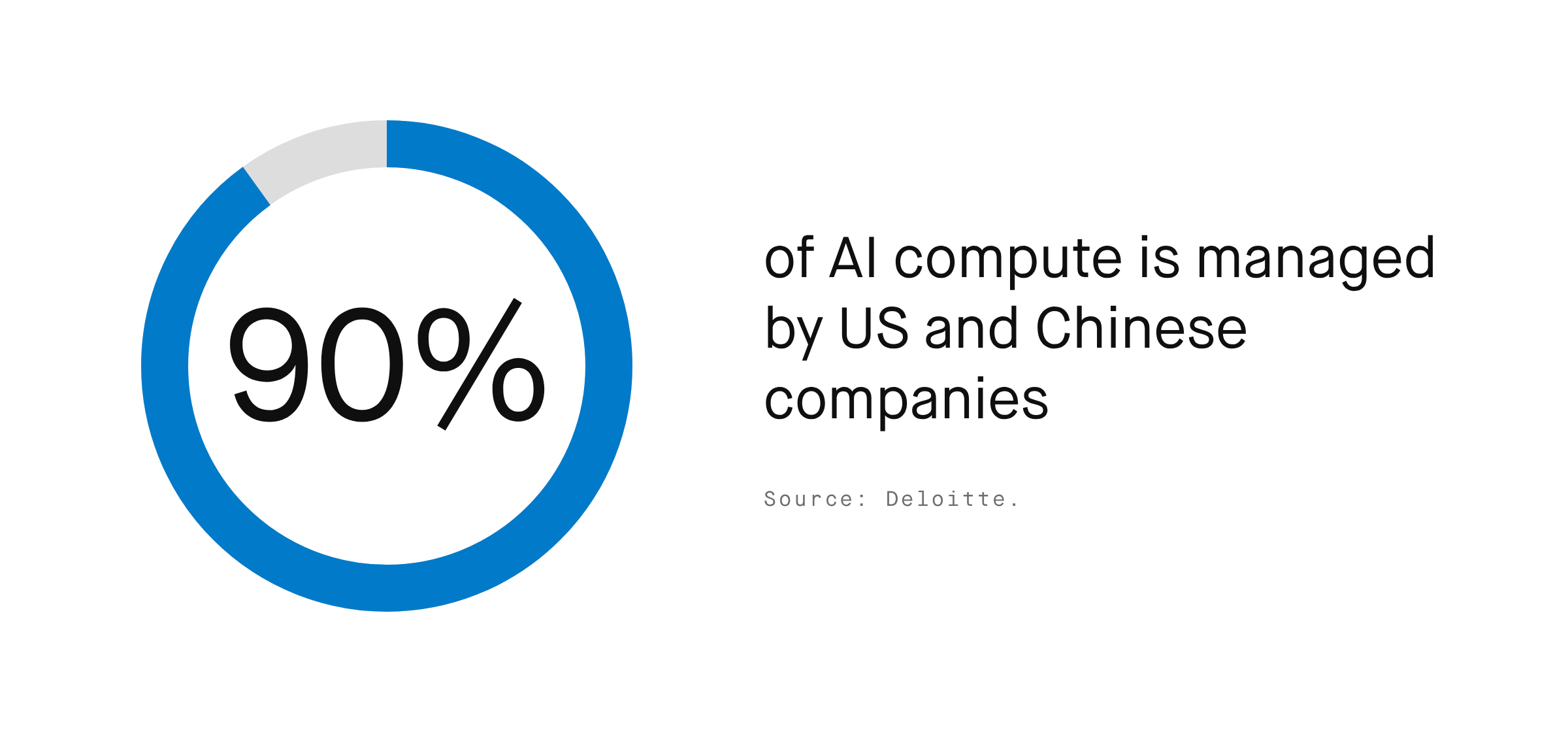
Two harder dependencies remain. The first is compute – the chips and processing power AI runs on. Deloitte's 2026 analysis finds that 90% of it is managed by US and Chinese companies, so even sovereign models can still depend on US-designed chips. The second is agentic AI. As autonomous systems make decisions without human approval at each step, governance needs to cover how they behave after deployment.
Sovereignty is also becoming a market advantage. Cohere finds that 37% of telecoms leaders and 32% of manufacturing leaders see sovereign AI as a reason clients choose them.
How intive approaches digital sovereignty
No one provider can cover every layer of sovereignty on its own. Partnerships fill that gap, connecting sovereign compliance with modern engineering practices.
At intive, we work with engineering and compliance teams to design sovereign architectures that are resilient and cover every layer of the stack. That includes finding the right balance between compliance, performance, and the freedom to switch vendors: assessing the risks in your current workloads, designing hybrid architectures, and choosing the mix of sovereign and hyperscale providers that fits your regulatory requirements.
Two partnerships support this work:
- As a STACKIT Silver Partner, we build on STACKIT's sovereign cloud to create architectures for clients who need firm control over where their data is located.
- Building on our Red Hat partnership of more than 10 years, we use Red Hat's enterprise open-source and hybrid cloud technologies, such as OpenShift, so clients can move workloads between cloud environments, keep control of them, and avoid depending on one vendor's proprietary stack.
Together, these let us help you match each workload to the right level of control – for your data, your cloud, and your AI.


