



For years, I’ve been working alongside media engineering teams and digital transformation leads, and I’ve heard the same siren song: “AI will revolutionize everything.” From automated editing to "set-and-forget" marketing, the promises have been grand. Yet, after years of helping media companies navigate the shift, a sobering reality sets in. Despite the billions poured into shiny new platforms, pilots, and partnerships, the truth is that most AI projects are failing to deliver a measurable financial return.
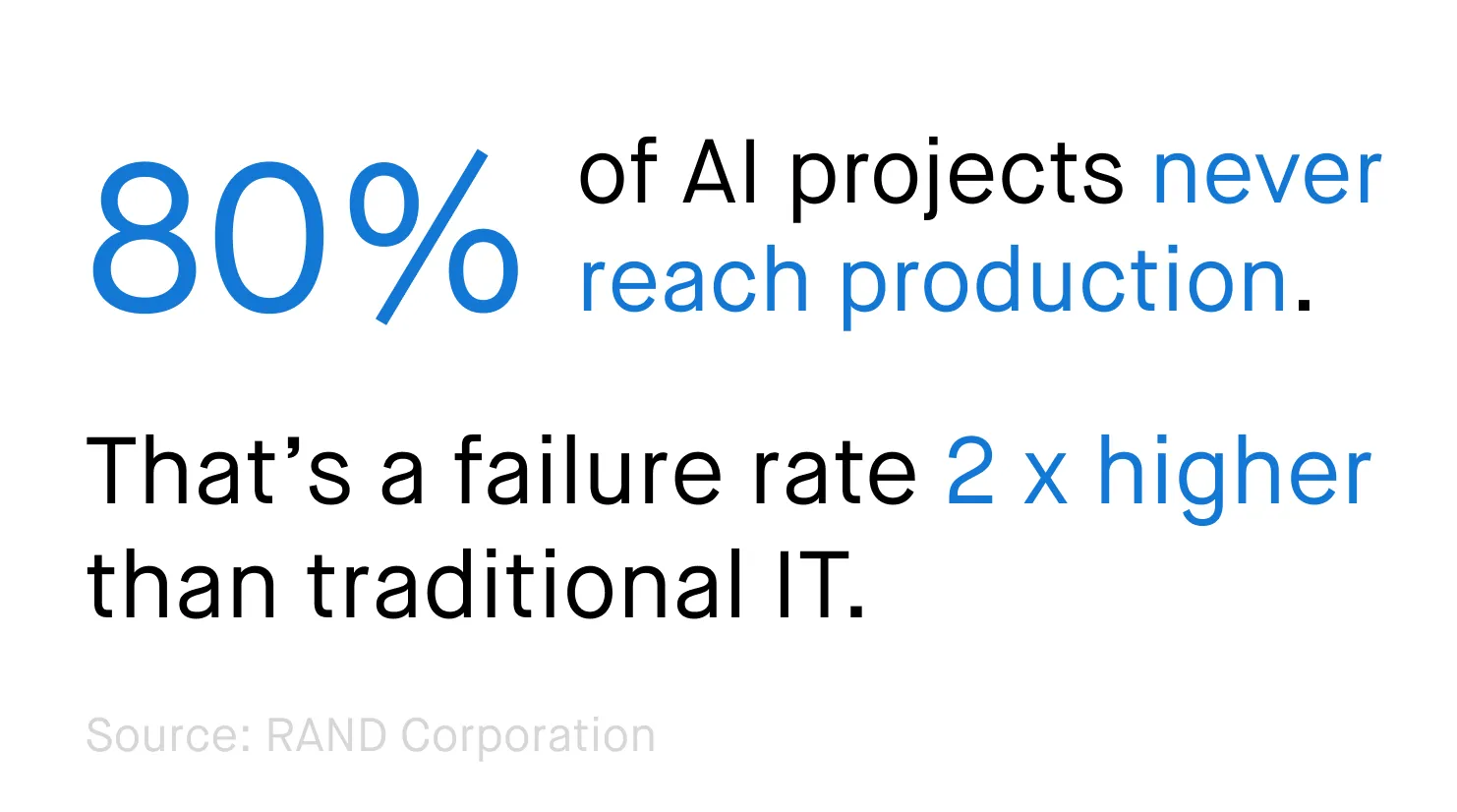
Across the enterprise landscape, recent studies show that more than 80% of AI projects fail to reach production – a failure rate twice as high as traditional IT projects [1]. Gartner reports that only 48% of AI projects ever make it out of the lab, with the average "prototype-to-production" timeline stretching to a grueling eight months [2].
Why the disconnect? From my point of view, the problem isn't the underlying architecture – it’s the lack of a business anchor. Too many projects treat AI as a “check-the-box" requirement. The most successful implementations I’ve seen are those that treat AI as a focused capital expenditure, demanding a quantifiable return by starting with the metric, not the model.
Don’t Fall for the Traps: Common Pitfalls in AI Adoption
Before you commit engineering resources, you must be honest about the technical hurdles. Most negative ROI stems from three predictable traps:
- The Hype Trap (The "Shiny Object" Syndrome): Chasing the latest “agentic AI” or high-parameter models before solving foundational workflow issues. Projects fail when they center on the technology instead of solving real problems for the end-users in the newsroom or the edit suite [1].
- The Data Readiness Trap: Trying to deploy sophisticated models on top of technical debt. Data quality remains the biggest roadblock to scaling, with 67% of data leaders struggling to transition even half of their pilots to production [2, 3]. If your metadata is siloed or inconsistent, your AI will be too.
- The Misaligned KPI Trap: Deploying an “efficient” solution that doesn't map to a core business metric. If your AI automates a process but requires more human oversight and compute cost than the manual task did, you’ve created a vanity project, not a value-add.
The Strategic ROI Framework: Three Pillars of Value
To ensure your investment delivers, focus on areas where the data is structured and the business impact is most immediate.
Pillar 1: Efficiency Wins (The Foundation)
The quickest ROI often comes from automating repetitive, high-compute tasks in content operations. These projects directly reduce operational overhead and reclaim thousands of manual hours.
- Metadata Automation: Using ML to automatically transcribe, tag, and categorize video assets for better searchability.
- QC & Compliance: Automated identification of technical errors (black frames, audio spikes) and compliance issues, accelerating ingest-to-distribution.
The Bottom Line: Organizations implementing these tools report 30–40% cost reductions and can produce up to 10x more content variations with the same resources [4, 8].

Pillar 2: Revenue Growth (The Accelerator)
Once the pipeline is optimized, the next step is leveraging AI to directly boost the top line through personalization and ad-tech optimization.
- Personalization & Recommendation: Fine-tuning content discovery to increase the velocity of consumption and session length.
- Dynamic Ad Insertion (DAI): Leveraging real-time viewing data and predictive modeling to maximize ad yield through better audience matching.
How we’ve approached this: A look behind the build at a Global News Publisher
The Challenge: A global financial news publisher was losing significant ad inventory to overly broad keyword-based blocklists. Any article mentioning a sensitive term – regardless of actual editorial context – was flagged as brand-unsafe, artificially shrinking the content pool available to advertisers and directly suppressing revenue.\
The intive Solution: we replaced the blunt keyword filter with a custom ML sentiment analysis model, tuned specifically to the publisher’s editorial vocabulary. Using the VADER sentiment framework as a foundation and training it on thousands of manually scored articles, the model learned to evaluate the emotional context of content – not just the presence of a flagged word. The system was integrated directly into the sales and ad operations platform.
The Result: 33% of brands requiring brand-safety measures adopted the new service, with a 100% client retention rate. Zero instances of ads appearing on genuinely unsuitable content were recorded. The expanded content inventory directly increased ad impressions and click-through rates, driving substantial ad revenue growth for the publisher by anchoring the AI investment to a clear metric: ad yield.
The Bottom Line: 74% of enterprises using GenAI in production are already seeing ROI, with customer engagement and sales lift being the primary drivers [5, 7].
Pillar 3: Engagement and Retention (The Long Game)
For subscription-based models (SVOD/AVOD), the goal is using AI to understand and predict viewer behavior to stem churn.
- Predictive Churn Analysis: Analyzing viewing patterns and support ticket history to identify at-risk subscribers before they cancel.
- Content Valuation & Scheduling: Using predictive analytics to guide commissioning decisions based on predicted audience size and financial performance.
How we’ve approached this: Use Case Discovery for a Digital Publishing Leader
Translating broad AI potential into a specific, high-value roadmap requires a disciplined discovery phase. We recently worked with a US-based digital publishing leader that wanted to explore Generative AI and Large Language Models, but needed a structured way to identify where the tech would actually create commercial value.
intive ran a structured AI Discovery & PoC Sprint across four weeks. Working with over 30 client stakeholders, the team surfaced 161 findings and pain points, eventually refining those down to 17 concrete solution proposals. From there, 8 high-priority PoCs were selected for rapid development – each with a functional prototype and a clear implementation plan.
The client selected 3 PoCs for full MVP development, including a Semantic Content Engine – a GenAI-powered discovery layer that delivers contextually relevant responses to user queries. This approach allowed the client to move past the initial hype and focus resources on a solution that directly drives subscriber engagement and retention.
The Bottom Line: High-performing models can achieve 91% churn prediction accuracy [9]. Companies using these models report 20–35% increases in Customer Lifetime Value (CLV) through targeted engagement [10].
intive POV: Building Your AI Business Case
AI is no longer a science project – it’s critical media infrastructure. To succeed, you need a partner who understands the bridge between a Python script and a production-ready system.
At intive, we move you from "pilot purgatory" to production reality by focusing on:
- Metric Alignment: Defining the exact KPI (e.g., "reduce cost-per-ingest by $X") before we architect the solution.
- Data Strategy First: Auditing and preparing your data to ensure it can actually fuel high-performing models.
- End-to-End Implementation: Taking the solution from a business case through to a scaled, production-ready deployment that delivers measurable ROI.
Sources:
- [1] RAND Corporation (2024): The Root Causes of Failure for Artificial Intelligence Projects. Link
- [2] Informatica/Gartner (2025): The Surprising Reason Most AI Projects Fail. Link
- [3] Informatica (2025): CDO Insights 2025. Link
- [4] Storyteq (2025): Can AI Content Generation Boost Your Content ROI? Link
- [5] Google Cloud / NRG (2024): The ROI of Gen AI in Media & Entertainment. Link
- [6] iOPEX Technologies (2025): Reengineering Ad Revenue Operations with Agentic AI. Link
- [7] Google Cloud (2024): The ROI of Gen AI: Global Survey Results. Link
- [8] Google Cloud (2025): The ROI of AI: How Agents Are Delivering for Business. Link
- [9] Apexon (2024): Streaming Service Revolutionizes Customer Retention with AI. Link
- [10] Digital Applied (2025): AI Predictive Analytics: CLV and Churn Models Guide. Link
.png)

.png)


.png)
.png)
.png)
.png)