


For most banking and fintech CTOs, there is a persistent cost to the organization that does not appear as a clear line item in the budget. It is a "silent tax" paid every time a regulatory update or a new feature launch leads to months of complex analysis, unforeseen delays, or unacceptable operational risks.
In 2026, the financial sector has reached a tipping point. With operating margins tightening and a relentless demand for innovation with leaner teams, the "business as usual" approach to legacy is no longer sustainable.
Whether it’s the race for superior user experience or regulatory compliance, banking institutions can no longer afford the months of rework and friction inherent in manual legacy analysis.
The Knowledge Debt Trap
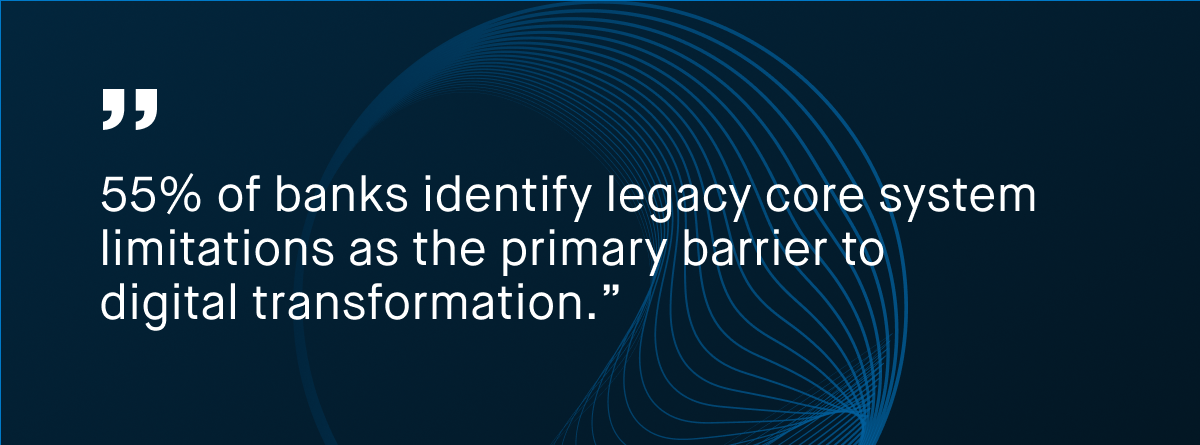
Industry research indicates that 55% of banks identify legacy core system limitations as the primary barrier to digital transformation, while many institutions continue to struggle with production bottlenecks that hinder scalability. This creates a state of Knowledge Debt, where the institution's business logic is effectively trapped within its own infrastructure.
This challenge is compounded by a growing talent gap. According to Gartner, over 40% of enterprise systems are already beyond end-of-life or support, and the pool of engineers capable of performing what might be called “digital archaeology” on undocumented systems is shrinking.
This scarcity reveals a deeper truth: the traditional model of relying on individual expertise to maintain legacy cores has reached its limit.
The Paradigm Shift: From Individual Speed to AI-Native Capacity
Giving developers basic AI assistants to write code faster won't fix a foundation that no one fully understands. To break this cycle, we must move beyond isolated AI productivity gains towards orchestrated organizational intelligence.
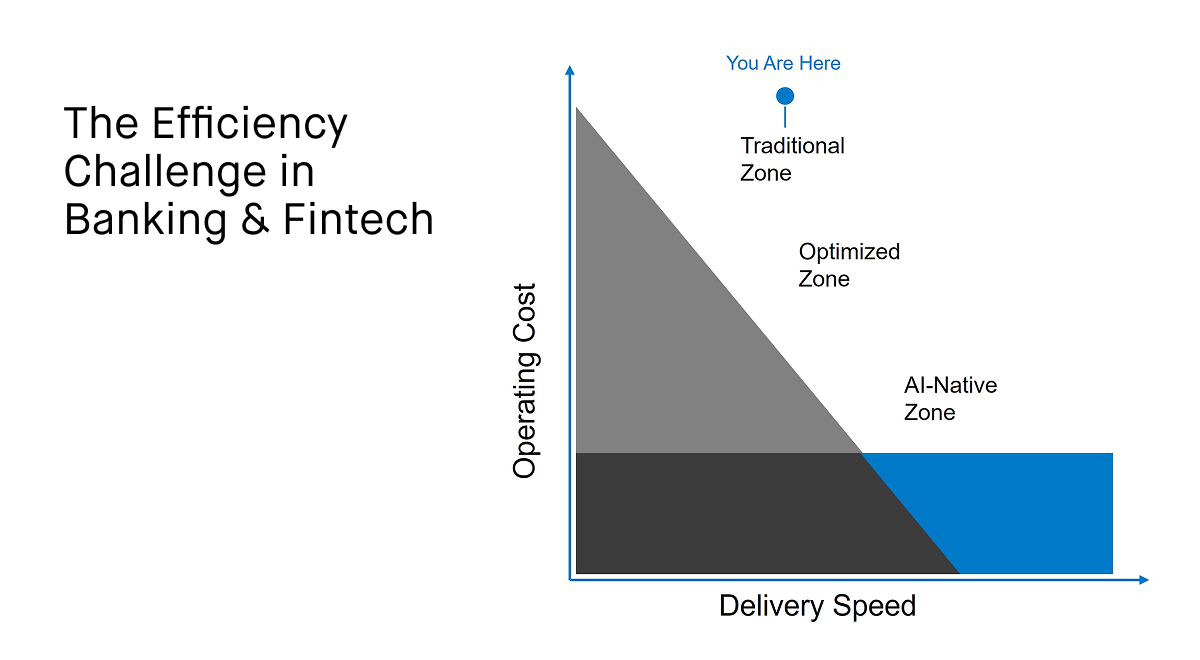
This is the 2026 paradigm shift: moving the entire engineering operation from the “Traditional Zone” of high-risk maintenance to an AI-native capacity. In this new model, we redefine the role of AI in the SDLC:
- From Copilots (Individual Efficiency): Personal productivity in everyday coding tasks.
- To Reusable AI Agents (Team Efficiency): Standardized playbooks and autonomous workflows that scale expertise.
- Towards a System of Organizational Knowledge (Institutional Impact): Building true institutional intelligence where legacy becomes a transparent and searchable asset. By capturing this knowledge, modernization becomes a repeatable process instead of a high-risk, one-off project.
Accelerating Legacy Migration through Agentic Evolution
To move from a state of "Knowledge Debt" to a System of Organizational Knowledge, we need more than just faster tools. We need Agentic Evolution: an approach where AI agents act as specialized partners throughout the entire modernization journey.
In the context of Legacy Migration, this shift drives efficiency across three critical fronts:
- Knowledge Recovery for Core Banking: Interrogating legacy code to surface business rules that have remained undocumented for years, providing a foundation for modernization without the risk of losing "tribal knowledge."
- Frontend Consistency & Multi-Channel Delivery: Drastically reducing the friction between design (Figma) and production-ready code to ensure a standardized UX as backends migrate.
- Standardized Quality Assurance: Generating automated tests to ensure functional equivalence, guaranteeing that "nothing breaks" during the transition.
The Path to Execution
Modernizing the core is no longer just a technical project; it is a strategic effort to reclaim engineering sovereignty.
By leveraging AI agents to decode legacy logic and automate quality, institutions can finally lift their innovation ceiling. This shift allows teams to move away from reactive maintenance towards an architecture that is inherently easier to evolve.
The real challenge for 2026, however, lies in how to transition towards this AI-native architecture without compromising operational stability.
Stay tuned for our next deep dive, where we will break down the intive AI-native framework – the roadmap to transforming individual AI gains into true organizational power.
.png)

.png)


.png)
.png)
.png)
.png)