


In 2026, AI is steadily becoming the structural backbone of business strategy and operations. What we’re seeing across industries is not hype-driven adoption, but deliberate scaling: agentic systems entering core workflows, governance frameworks maturing, and enterprises reassessing how value is measured.
This article outlines the major AI trends shaping business in 2026, based on the current changes organizations are navigating today.
Trend #1: Agentic AI Moves from Pilots to Core Workflows
The defining shift of 2026 is clear: agentic AI is moving from controlled pilots into core enterprise workflows.
From Copilots to Workflow Owners
Copilots and general-purpose AI chat assistants are now adopted in most organizations. What began as productivity support tools have become standard digital collaborators.
But the next step is more complex:

- Agentic assistants and workflow agents are moving into production across various functions

- Long-running and highly autonomous agentic workflows are executed remotely via simple interfaces

- Agentic AI systems are being given even more autonomy
We are witnessing the early stages of the agentic enterprise, where AI does not merely assist, but executes end-to-end processes. We’re seeing workflow agents handling procurement steps, supporting IT operations, assisting with compliance documentation, and managing structured customer service processes.
More advanced use cases are also emerging: long-running, semi-autonomous agents that execute processes remotely, triggered through simple interfaces. These systems can monitor, update, and complete tasks over time with limited human intervention. While still supervised and carefully controlled, they represent a meaningful shift from “ask-and-answer” AI to “plan-and-act” AI.
However, autonomy without oversight is not viable. Success depends on governance, cost control, and demonstrable value. Where those elements are missing, many AI projects simply won’t make it past the pilot stage.
Trend #2. On-device/edge AI for Privacy-Sensitive Scenarios
AI is starting to live right where the data is created. For privacy-sensitive or time-critical tasks, companies are running smaller AI models directly on devices instead of sending everything to the cloud. This keeps data safer, speeds up responses, and gives organizations more control over sensitive information.
It’s not yet widespread, but on-device and edge AI are steadily gaining ground, especially in healthcare, finance, industrial settings, and other areas where privacy and speed matter most. The trend is clear: more AI will run locally, right where it’s needed.

At the same time, most AI workloads still live in the cloud, where companies manage privacy and compliance through strong policies, service-level agreements, strict data retention, and detailed logging.
Geopolitical tensions are pushing organizations to think differently about their AI infrastructure. More companies are investing in data sovereignty: keeping sensitive data and AI systems under local control, reducing reliance on foreign tech providers, and ensuring compliance with regional data laws.
Trend #3: Governance-by-Design Becomes Standard
AI governance can’t be reactive. In 2026, governance-by-design is becoming standard practice. Standards are maturing and are more widely adopted. Two frameworks in particular are gaining real traction:
- National Institute of Standards and Technology AI Risk Management Framework (NIST AI RMF), which provides a structured approach for identifying, assessing, and managing AI-related risks across the lifecycle of an AI system
- ISO/IEC 42001 for organization-wide AI management systems
These frameworks are increasingly referenced in enterprise AI programs.
Regulatory Pressure Increases Operational Complexity
Regulatory and legal exposure is becoming a board-level concern. The EU AI Act introduces specific requirements for General-Purpose AI (GPAI) models, including foundation models that can be integrated across multiple downstream applications. The EU AI Act is structured around a risk-based approach, and similar thinking is emerging globally. Non-compliance carries substantial financial penalties, reputational risk, and potential operational disruption.
Companies are now more aware of the details of their AI offerings. They must account for additional work, additional roles, and expanded documentation requirements to satisfy public policy obligations. This effectively increases the cost of delivering AI systems.
Governance is now a structural component of AI architecture.
Trend #4: Measuring Real-World Impact, Beyond Adoption
Despite widespread AI experimentation, adoption and impact remain uneven. Many organizations report limited enterprise-scale impact and modest financial outcomes.
To close this gap, disciplined evaluation methods are becoming standard practice:
- Controlled pilots
- A/B testing
- Human-in-the-loop QA
- Production observability
- Clear ROI attribution models tied to productivity, revenue lift, or cost reduction
These are no longer experimental techniques; they are regular components of AI project delivery.
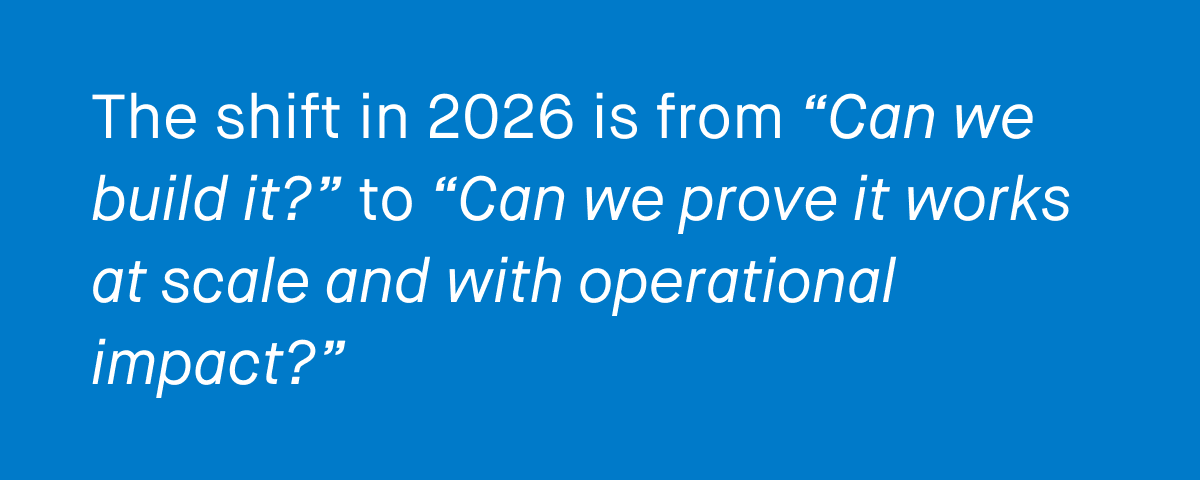
Rather than counting deployments, mature organizations now measure:
- Decision cycle time reduction
- Revenue per employee improvement
- Cost-to-serve optimization
- Error rate reduction
- Automation coverage of end-to-end workflows
The shift is clear: AI success is about real value.
intive’s GenAI Sprint takes a value-first approach to AI innovation. Over four weeks, we first explore the problem space and identify the true levers for change, then rapidly prototype and test feasibility with GenAI tools. In the final phase, we structure insights into a clear path to production, complete with stakeholder-ready materials. This ensures AI is applied where it delivers real, measurable impact, not just innovation for its own sake.
Scaling AI: The Biggest Enterprise Risks
As AI scales, complexity compounds. The most pressing risks fall into five categories:
1. Skills and Integration Gaps
AI systems must integrate into legacy ERP, CRM, and data environments. Organizations often underestimate the engineering and change-management burden required.
2. Data Complexity
Fragmented, inconsistent, or poorly governed data undermines AI effectiveness. Scaling AI requires scalable data architecture.
3. Cost and Sustainability
Compute costs are rising. Energy consumption and carbon footprint are coming under scrutiny from regulators and stakeholders. AI sustainability became a strategic priority.
4. Governance and Regulatory Exposure
Compliance obligations are increasing. Regulatory compliance is expanding AI program scope, requiring new roles, controls, and documentation, which increases cost and slows naive experimentation.
5. Cultural Transformation
The most overlooked risk is cultural. AI transformation must happen through people, not to them. Organizations that fail to align efforts, train employees, and redesign workflows will see adoption without value.
To help organizations move beyond isolated AI pilots and make AI a core part of their business, we at intive offer AI‑native transformation. Our approach guides companies in redesigning processes, technology, and governance so that AI is embedded into the way they operate. By aligning privacy, performance, and strategic goals from the ground up, we enable enterprises to turn AI into a reliable, scalable, and value-creating capability.
The Next 3–5 Years: AI Opportunities and Disruptions
AI is moving from assisting humans to running critical business processes. End-to-end workflow agents will expand rapidly, creating huge commercial potential, but only for organizations that get governance, costs, and measurable value right. Projects that fail on these fronts are likely to be canceled.
Service businesses face both opportunity and threat. Companies that transform operations in the next 12–18 months will gain a lasting competitive edge. As AI agents take on more responsibility, AI sovereignty will become essential, driving investment in local control and enterprise AI Ops platforms.
Additional shifts on the horizon:
- Sustainability as a competitive differentiator
- Governance standardization across AI systems
- The rise of AI-generated content, making it nearly impossible to tell human from machine output
- Traditional apps and brand interfaces risk becoming irrelevant as users interact with personalized AI-driven experiences
The future of AI is autonomous, strategic, and radically reshaping how businesses operate and how users consume information. If you’d like to explore how these shifts connect with your specific challenges, our AI team is always happy to connect.
.png)

.png)


.png)
.png)
.png)
.png)