



Over the past two years, almost every engineering organization we work with has rolled out AI coding tools. Google's DORA research team reports that 90% of technology professionals now use AI at work, and over 80% believe it has made them more productive. But… the business results tell a different story.
Teams with high AI adoption often complete more tasks and merge more pull requests, yet the business doesn't see a matching improvement. More code – same outcomes.
It's a gap we hear about often from engineering leaders who come to intive for support. Their AI dashboards show record pull request volume, yet product releases reach customers no faster than before. The cause is usually the same: treating AI as a productivity boost for individual developers while the operating model around them stays the same. Over the past year we've changed how our own delivery works, and we're helping clients do the same. Here's what we're observing.
Coding was never the whole bottleneck
From what I see in my work, even a big jump in coding speed doesn't necessarily lead to faster delivery. In many projects, coding is just a small part – the rest of the time goes to everything around it: requirements, handoffs, reviews, QA cycles, security checks and release windows. Each handoff adds waiting time and loses context. A product manager writes the ticket, an architect designs, a lead breaks it down, developers build and QA tests. Speed up one of those steps, and the work simply reaches the next queue sooner. Bain & Company's Technology Report 2026 describes the same pattern: "Code ships faster than ever, but the approvals, handoffs, and escalations around it haven't moved."
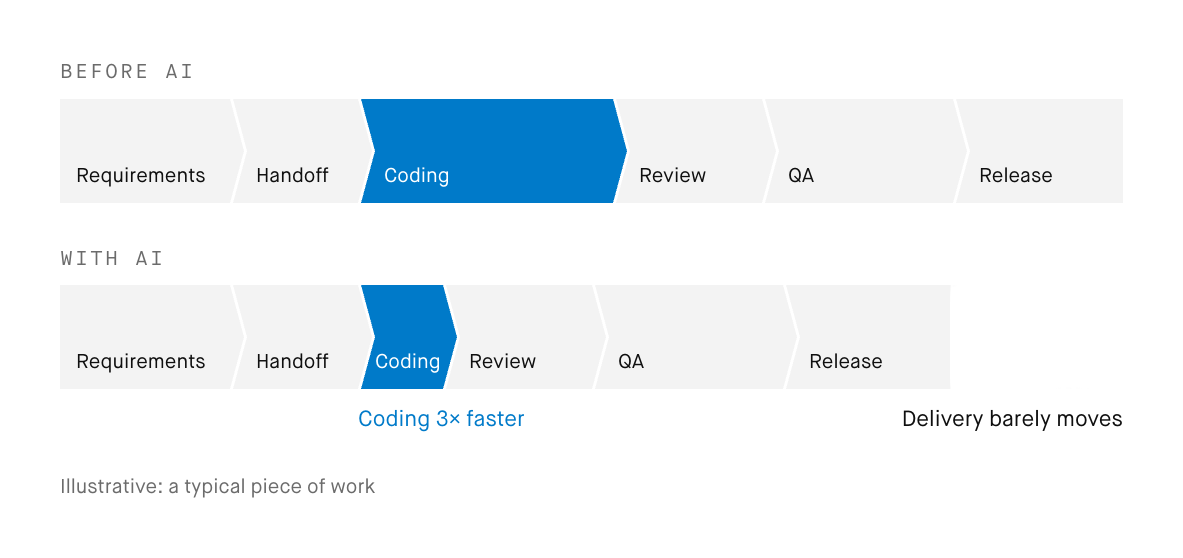
Why your dashboard won't warn you
If the gains disappear, why don't the numbers show it? Most AI dashboards measure activity: licenses, tokens consumed, pull requests, story points. They're easy to report, and they say nothing about whether the right thing reached a customer. Decades ago, Edsger Dijkstra argued that if we must count lines of code, we should book them as "lines spent" rather than "lines produced." Tokens deserve the same treatment: they belong on the cost side of the ledger.
What we changed: moving people to intent and verification
Turning faster coding into faster delivery means moving human effort to the parts of delivery AI can't own. That is what we mean by AI-native at intive: AI owns the execution layer, while people own the intent and verification layers, and steer the work in between. In practice, that human work sits in three layers:
- Intent – deciding what should exist and why. It's the most expensive human time in any company, and the most undervalued. Weak intent means agents build the wrong thing very fast.
- Direction – turning intent into work AI agents can execute, reviewing what comes back and refining the specification.
- Verification – confirming that the result matches the intent, which goes deeper than test coverage.
In the "manual" era, most engineering effort went into implementation. In our AI-native teams, a growing share goes into the layers before and after it. That's also where our senior people add the most value.
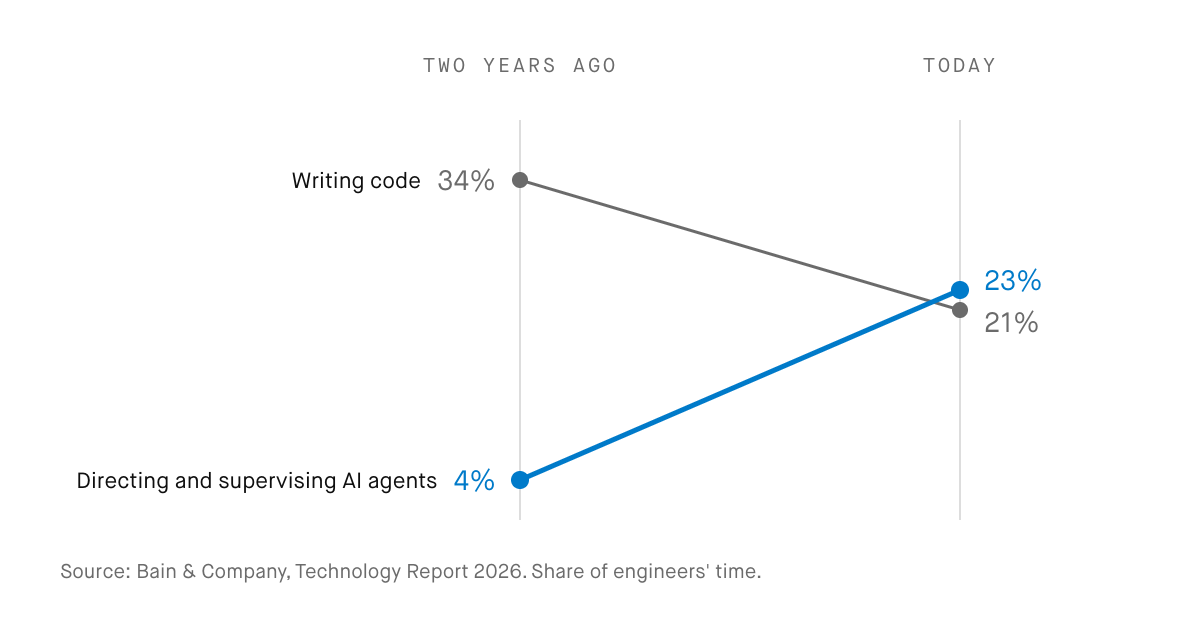
Bain's 2026 survey shows this shift is already underway. Engineers now spend 21% of their time writing code, down from 34% two years ago, and 23% directing and supervising AI agents, up from 4%.
Case study: AI built into how a regional bank delivers software
One of intive's clients in Latin America is a large regional bank that needed to move off legacy digital channels, reduce its reliance on external providers and shorten time-to-market – all under tight delivery constraints. We work alongside the bank’s own teams on this transformation, and the three layers shape how we set it up.
Intent. We started by defining what the platform had to achieve for the business: strong internal ownership, sharp customer segmentation and fast execution. Those goals shaped the architecture – a modular digital platform and middleware layer that reduces dependency on legacy systems – and set what teams build before any AI-generated code enters the picture.
Direction. AI is part of the everyday workflow – code scaffolding, unit test generation and documentation. We also work with a dedicated bank team on AI governance: shared practices across all teams, plus agents, skills and harnesses built on the bank’s own design system and coding standards. AI works within rules the bank owns. One result: a lean team of three developers, working with AI, built a backoffice application that started as a proof of concept and now runs in production.
Verification. Generated tests and documentation keep the system understandable as it grows:
- Unit test coverage: from 70–80% to 90–95%
- Documentation coverage: from 0% to 85–95%
- Unit test creation time: down 80–90%
- New developer onboarding: from 2–3 weeks to 3–5 days
These numbers measure understanding as much as speed – they give the bank a platform its own teams can explain, maintain and evolve independently.
Where to start: five questions for your leadership team
If you'd like to assess where your own organization stands, start with a few honest questions. These are the ones I bring to client steering committees. The answers show quickly whether your AI gains are getting stuck before they reach delivery.
- Where does a typical piece of work spend most of its time? If it isn't at the keyboard, coding tools won't move your roadmap.
- How many people handle a requirement before it reaches a customer? Each handoff adds a delay AI won't remove for you.
- What do you report as AI progress? If it's licenses, tokens or PR volume, you're measuring the machine.
- How has your review process changed since AI arrived? If it hasn't, comprehension is falling behind output.
- Who owns the quality of your specifications? If nobody does, agents fill the gaps with plausible guesses.
If the answers point to a gap, look at the operating model around your tools. That's where AI speed either turns into faster delivery or gets stuck. You can read more about our approach to AI-native transformation – and if you'd like to discuss what this means for your teams, feel free to reach out.



